
Photo: Ben Elliott / Unsplash
Twenty’s Plenty
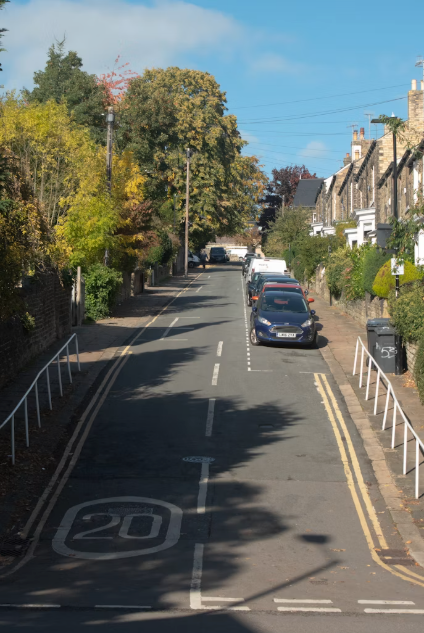
“Twenty’s Plenty” is the campaign for a default 20mph speed limit on residential streets and in town and village centres — anywhere people are walking, cycling and living close to traffic. Unlike active travel, this is not an issue where everyone agrees. Drivers, businesses and some councils have real concerns about journey times, cost and enforcement. But the case for 20mph rests on one simple, hard-to-argue-with fact: at lower speeds, a driver has more time to stop, and a pedestrian who is hit is far more likely to survive.
What local people say
Eastbourne’s own 20mph story is one of genuine disagreement — a cross-party group of campaigners pushing hard, and a highways authority that has, so far, held back. Both sides are on the record.
“They are letting perfection be the enemy… They are ignoring all the evidence that simply by changing a speed limit using signs, people will travel more slowly. They might break the 20mph speed limit — but it will be at a lower level. Just because you haven’t got the money to do the engineering, doesn’t stop you getting the speeds down — East Sussex is one of the most backward local authorities in this.”Adrian Berendt, South of England organiser for 20’s Plenty for Us, responding to East Sussex County Council’s cost concerns (Eastbourne Reporter, December 2023)
“We support 20mph speed limits where they are appropriate and have a number in East Sussex, including town centre roads in Eastbourne. The introduction of a lower speed limit will not automatically slow traffic down, and whilst a 20mph speed limit can be effective with signs alone on roads where the average traffic speed is below 24mph, on roads where average speeds are higher there would need to be significant and costly traffic management measures put in place.”East Sussex County Council spokesperson, responding to the Eastbourne Reporter, December 2023
“I saw a film that demonstrated the impact the collision impact between car and child… 40mph was the graveyard slot clearly, 30mph was life-changing injuries, at 20mph he lived to tell the tale. Nothing spoke more to me about what 20mph limit might mean, so I’ll take that up.”Caroline Ansell, then Eastbourne’s Conservative MP, on a speed awareness course video, speaking at a local sustainable transport summit
“Evidence shows 20mph limits increase a pedestrian’s chance of survival if hit by a car, improve the quality of life for those living in a 20mph zone, lead to calmer streets and improved community cohesion, and reduce pollution.”From the motion unanimously agreed by East Sussex County Council, put forward by Cllr Kathryn Field (Lib Dem) and then-Cllr Brett Wright (Green), 10 February 2026
A cross-party group — Liberal Democrat and Conservative councillors, members of Bespoke Cycle Group and other transport campaigners — began meeting at Eastbourne Town Hall in December 2023 to plan a campaign for residential 20mph limits. East Sussex County Council, as highways authority, has said wide-area 20mph is “not a priority,” instead funding a £500,000 ‘Speed Management Programme’ covering more than 25 unspecified stretches of road over three years. In February 2026, the council unanimously backed a motion to align new-development planning policy with lower speed limits and review its approach once fresh government guidance arrives — a real, if modest, sign of movement.
See the crash data for yourself
CrashMap is a free, public tool built on official Department for Transport figures, showing every police-recorded injury collision on Britain’s roads back to 1999. Search it for Eastbourne to see exactly where people have been killed or seriously injured near you.
Browse the interactive crash map →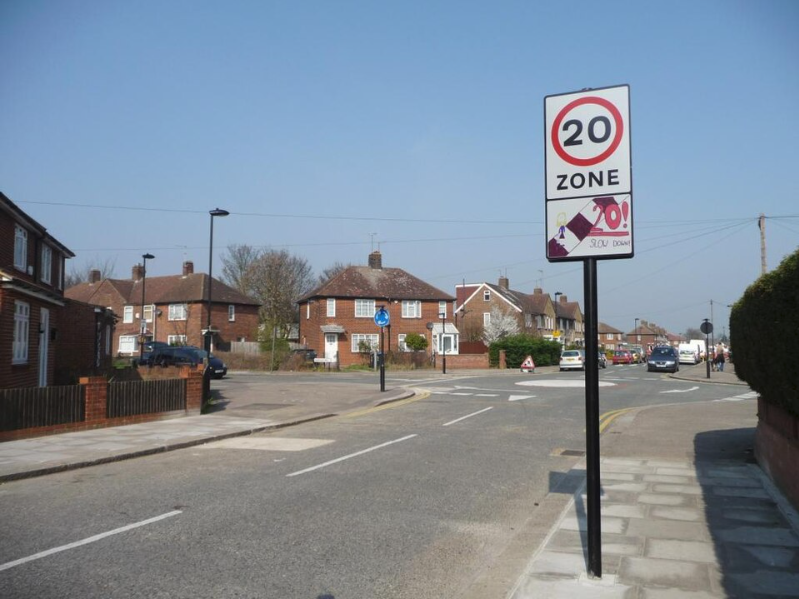
Photo: Christine Johnstone / Geograph, CC BY-SA 2.0
What’s happening elsewhere
Eastbourne isn’t deciding this in isolation. Wales has already made the change nationally, Oxfordshire has built one of England’s largest local programmes, and Parliament is right now asking whether England should follow.
Central government. The Government published its Road Safety Strategy in January 2026. The House of Commons Transport Committee is currently holding an inquiry into it, and gave over an entire evidence session, on 15 July 2026, to the question of speed. Witnesses — including Transport for London’s chief safety officer, a pre-hospital emergency doctor, and Adrian Berendt of 20’s Plenty for Us, the same campaigner quoted above — argued the strategy doesn’t go far enough, and recommended a national default of 20mph on residential and urban roads rather than leaving it to local guidance alone.
“We have extrapolated the Welsh results to England, and our calculation is nine fewer KSIs [killed or seriously injured]. There are nine more KSIs per day in England because we have 30mph rather than 20mph. There are nine people being seriously injured or dying today, tomorrow and every day until we make the change. Speed is of the essence in this context.”Adrian Berendt, giving evidence to the House of Commons Transport Committee, 15 July 2026
Wales. In September 2023, Wales became the first UK nation to make 20mph the default limit on restricted roads, taking its coverage from 2% to 37% of the network overnight. Two and a half years on, the independent research service of the Welsh Parliament found that collisions on 20mph/30mph roads had fallen 22.5% and casualties 23.8% — both far outpacing the equivalent falls in England and Scotland over the same period. The rollout wasn’t painless: after criticism that some main roads had been swept in unnecessarily, the Welsh Government revised its guidance in 2024 to make it easier for councils to exempt faster through-roads — moving Wales’s approach closer to the locally-tailored model Oxfordshire had already been using.
“My experience is also very positive. I recently started cycling with my two young sons on a cargo bike, and generally it feels safe cycling with them. Traffic speeds seem appropriate most of the time, and drivers are generally considerate. I don’t think I would have been as confident before the scheme went in.”Holly Mullen, transport consultant based in Wales, on the 20mph rollout (Phil Jones Associates, May 2026)
Oxfordshire. Rather than a single overnight switch, Oxfordshire built its programme town by town: an £8 million, three-year fund lets any parish or town council apply for 20mph, provided the local county councillor and community support it. By September 2024, more than 200 schemes had been approved. The advice from Oxfordshire’s own cabinet member for transport is that this local, sign-only, community-led model got results without the “significant and costly traffic management measures” East Sussex has cited as a barrier.
“This is an incredible landmark and I want to thank all the communities who have been in touch with us, asking to make their residential streets safer and more pleasant places… Throughout the delivery of this programme we have been clear about the advantages it brings. You are seven times more likely to survive if you are hit by a car driving at 20mph than if you are hit at 30mph. Reducing speeds in residential areas is a vital pillar of our commitment to Vision Zero — our ambition to eliminate deaths and serious injuries from road traffic collisions in Oxfordshire by 2050.”Cllr Andrew Gant, Oxfordshire County Council’s Cabinet Member for Transport Management, September 2024
20’s Plenty for Us. The national campaign now has more than 700 local branches, and Scotland has committed to a full council-by-council rollout during 2026. Its founder, Rod King MBE, argues the evidence gathered from authorities that have already gone wide-area is unambiguous:
“The increasing evidence from local authorities who have already implemented wide area 20mph limits shows clear benefits on casualty reduction… There really can be little argument against 20mph as the limit for most urban and village roads. Local and national government should stop ‘kicking the can down the road’ on replacing an 80 year old 30mph limit, that never had any scientific basis, with one appropriate for the 21st century.”Rod King MBE, Founder and Campaign Director, 20’s Plenty for Us
The evidence
- A pedestrian is around seven times more likely to survive being hit by a car at 20mph than at 30mph (Oxfordshire County Council).
- Transport for London’s 10-year study of London boroughs found a 34% reduction in people killed or seriously injured on 20mph roads, rising to 70% among children — evidence given directly to Parliament in July 2026.
- Collisions on Wales’s 20mph/30mph roads fell 22.5% and casualties fell 23.8% in the period after its default limit began, against falls of just 4.7% and 5.2% on equivalent roads in England (Senedd Research, March 2026).
- Oxfordshire delivered over 200 sign-only 20mph schemes for £8 million across three years — directly rebutting the argument that lower limits require expensive engineering to work.
- CrashMap, the free public DfT-data tool, recorded 45 pedestrian casualties in a single Eastbourne town-centre search area over five years, 12 of them serious — check the live map above for up-to-date local figures.
- 20’s Plenty for Us calculates that England sees roughly nine more people killed or seriously injured every day than it would under a 20mph default, based on Wales’s results.
What you can do
As an individual
- Search CrashMap for your own street and see what’s actually happened nearby.
- When East Sussex County Council or Eastbourne Borough Council consult on speed limits or new developments, respond — the February 2026 motion only covers new streets so far.
- Talk to a sceptical neighbour about the survival-rate evidence above — it changes more minds than arguments about journey times.
- Follow the debate: East Sussex’s next Speed Management Programme decisions are worth watching closely.
As a grassroots effort
- Join or help form a local 20’s Plenty branch for Eastbourne — their free checklist covers everything from council motions to media outreach.
- Support the cross-party group of councillors and campaigners who began meeting in December 2023 to push for residential 20mph limits.
- Write to East Sussex’s Cabinet Member for Transport asking which roads the £500,000 Speed Management Programme will actually cover, and when.
- Ask your councillor to extend February 2026’s new-developments motion to existing residential streets, not just new ones.
References
- Oxfordshire County Council, Number of 20mph schemes approved in Oxfordshire passes the 200 mark, September 2024 — news.oxfordshire.gov.uk
- Oxfordshire County Council, £8 million approved to roll out 20mph project across Oxfordshire in next three years, February 2022 — news.oxfordshire.gov.uk
- UK Parliament Transport Committee, oral evidence on road safety and speed, 15 July 2026 — committees.parliament.uk
- Senedd Research (Welsh Parliament), What impact has 20mph had on road safety in Wales?, March 2026 — research.senedd.wales
- Phil Jones Associates, Two and a half years on — saving lives with Wales’ 20mph speed limit, May 2026 — pja.co.uk
- Eastbourne Reporter, Could Eastbourne have more 20mph speed limits?, December 2023 — eastbournereporter.co.uk
- East Sussex County Council, Notice of Motion — Speed limits in new developments, 10 February 2026 — democracy.eastsussex.gov.uk
- 20’s Plenty for Us, Plan Your 20mph Campaign: A Checklist — 20splenty.org
- 20’s Plenty for Us, Reducing speed limits from 30mph to 20mph typically results in more than 20% fewer casualties — 20splenty.org
- CrashMap — UK Road Safety Map, official DfT collision data — crashmap.co.uk