
Pavements
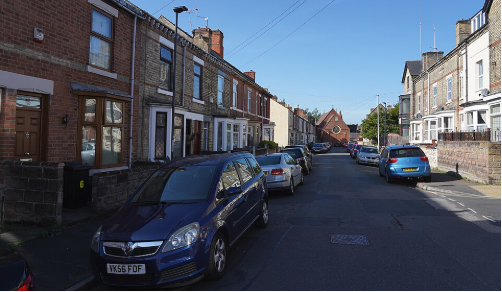
Photo: Malcolm Neal / Geograph, CC BY-SA 2.0
Pavements
Clear, well-maintained pavements are something most of us only notice when they’re not there. For a wheelchair user, someone with sight loss, an older person with a walking frame, or a parent with a pushchair, a car parked across the footway or a cracked, uneven slab isn’t an inconvenience — it can be the difference between getting to the shops safely and not going out at all.
The human cost
Start with the people most affected, and the picture is stark. Guide Dogs’ own survey of nearly 2,000 people found that vehicles parked on pavements had caused a problem in the past year for 95% of people with a vision impairment, 98% of wheelchair users, 92% of people with hearing impairments and 89% of people with other disabilities. Roughly one in five people with sight loss said they had actually been injured — walking into a car or its wing mirror they couldn’t detect in time. RNIB’s research tells a similar story: 82% of people they surveyed said parked vehicles on pavements were a big barrier, and 61% said it stopped them making all the journeys they wanted to make.
The effects go well beyond the moment of collision. Older people and disabled pedestrians who can’t trust the pavement often shorten their journeys, stop travelling unaccompanied, or stop leaving the house altogether — with real consequences for independence, loneliness and mental health, and for older people specifically, a higher likelihood of eventually needing residential care. Pavement parking also damages the pavement itself: paving isn’t built to carry a car’s weight, so slabs crack and shift, creating trip hazards for absolutely everyone, disabled or not.
Why people park on pavements — and why it’s often not really their fault
It’s easy to frame this as thoughtless driving. The evidence suggests something more complicated, and more structural. Much of Eastbourne, like many English seaside and market towns, is built around Victorian and Edwardian terraces never designed with car ownership in mind — roads simply aren’t wide enough for two-way traffic, parked cars on both sides, and a clear pavement all at once. Almost a quarter of drivers say they deliberately put two wheels on the kerb specifically so buses, bin lorries or ambulances can still get past — they’re trying to avoid blocking the road, not trying to block the pavement. Newer estates have the reverse problem: streets are built narrow to keep speeds down, but often without enough off-street parking for the number of cars each household actually owns.
Awareness plays a role too. Only around one in twenty drivers actually know the legal position on pavement parking — outside London and Scotland, the law is genuinely unclear and inconsistently enforced, which makes it hard to blame individual drivers for a problem that’s really about street design, housing-estate planning and patchy law going back decades. None of that makes the impact on pedestrians any less real — but it does mean the fix has to be about infrastructure and consistent rules, not just telling drivers to do better.
What local disability groups say
Eastbourne Access Group has been raising this for years. When the Government first consulted on a pavement parking crackdown in 2020, two of the group’s members spoke to the local press:
“I’m very much in favour of the idea because pavement parking has been the bane of people’s lives in Eastbourne for a long time. Disabled people have been very poorly served, it would be great if this becomes a national requirement. I’m absolutely in favour, bring it on.”Ian Westgate, Eastbourne Access Group, a wheelchair user (Sussex Express, March 2020)
“Vehicles on footways can cause obstruction and inhibit the independence of vulnerable people in our town, especially older people, those with disabilities or with visual impairment. Pavements are also not built to withstand the weight of vehicles, thus they often break up and damage what should be safe walking spaces. This brings added danger to pedestrians and financial repair burdens for our cash-strapped councils.”Ray Blakebrough, Eastbourne Access Group (Sussex Express, March 2020)
“People with sight loss say it has made a real difference. By keeping pavements clear, the new rules have helped to ensure that people in the capital can get out and about safely, without the fear of being forced on to the road by inconsiderate parking.”Mike Moore, Policy and Campaigns Manager, Guide Dogs Scotland, on Edinburgh’s pavement parking ban, one year on
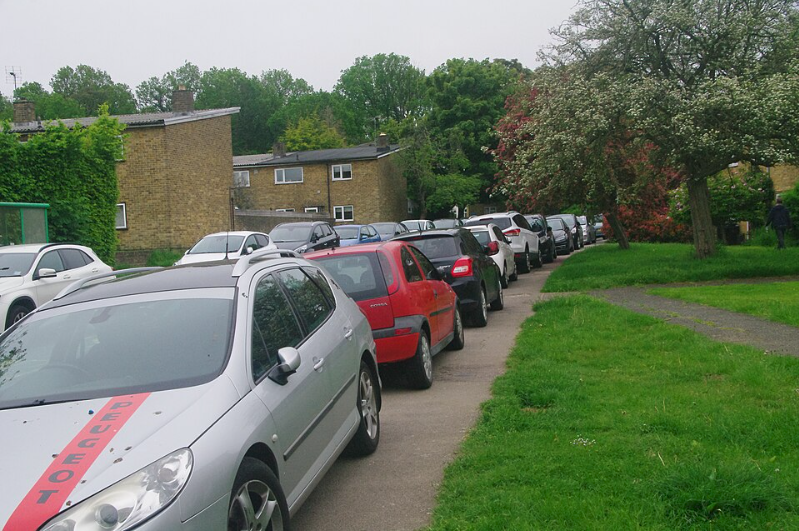
Photo: Mutney / Wikimedia Commons, CC BY-SA 4.0
What delivery companies and drivers say
Delivery and courier vans are a real part of this picture too, not just private cars. In Kingswood, South Gloucestershire, residents of Woodlands Terrace complained that up to 15 Royal Mail vans were parked on their street — many on the kerb — every single day, several of them staff cars for a nearby delivery office rather than vehicles actually out delivering.
“[Royal Mail] should not be using local residential roads to park their vans, at all times.”Emily, resident of Woodlands Terrace, Kingswood
“We have used these roads on a temporary basis while we secure suitable alternative parking for our vehicles. We’re genuinely sorry for the disruption this has caused to residents.”Royal Mail spokesperson, responding to BBC Bristol
It’s worth saying that some kerbside stops by delivery drivers are legal: vehicles can load or unload on single or double yellow lines for up to 40 minutes provided there’s no loading ban shown by kerb markings. The complaint from residents and disability groups alike isn’t really about a driver stopping briefly to deliver a parcel — it’s about vehicles parked for hours, blocking the full width of the pavement, with nowhere else provided for them to go.
Individual drivers, for their part, broadly agree something needs to change. RAC research published in 2025 found 83% of drivers want the Government to act, and two-thirds say they see vehicles blocking pavements near where they live — a third of those see it every single day. But drivers are genuinely split on the solution: 42% want an outright ban, 41% instead want councils given easier powers to ban it street-by-street.
“No pavement user should be forced into walking or wheeling into the road because of someone parking inconsiderately. A clear majority of drivers agree and want to see an end to needless pavement parking that causes accessibility problems, but when it comes to the solution, the jury is out.”Rod Dennis, RAC senior policy officer
Government and local action — what’s actually worked
This is one of the few areas of transport policy with a genuine, measurable UK success story. London has banned pavement parking outright since 1974. Scotland followed with a national ban under the Transport (Scotland) Act 2019; enforcement has rolled out council-by-council since 2023, and by late 2025, 21 of Scotland’s 32 local authorities were actively enforcing it, with £100 fines (£50 if paid within 14 days).
Edinburgh, the first Scottish council to enforce the ban with no streets exempted, marked one year of enforcement in January 2025 to strong reviews from the very groups most affected:
“We’ve seen many residents and visitors modify their parking habits accordingly, with the problem of pavement parking disappearing in many streets across our city… We’ve also heard from many people who really appreciate clearer, wider pavements and who no longer need to walk on the road as a result of the ban.”Cllr Stephen Jenkinson, Transport and Environment Convener, City of Edinburgh Council
“So many streets that have been blighted in the past are now free and accessible for people who move around the city like me who uses a power wheelchair. Pavements are for people.”Cllr Kayleigh O’Neill, Transport and Local Access Forum Convener, City of Edinburgh Council
“This has been the most significant change to make Edinburgh a safer and more attractive city for pedestrians since the introduction of widespread 20mph speed limits.”David Hunter, Living Streets Edinburgh Group Convener
The picture in England is different, and only just starting to move. In 2026 the Government ruled out a national ban outside London, but after “more than five decades of campaigning by Living Streets and supporters,” the English Devolution and Community Empowerment Bill — which reached Royal Assent on 29 April 2026 — gives local authorities new, easier opt-in powers to restrict pavement parking area by area, rather than street-by-street Traffic Regulation Orders. DfT guidance on using these powers is expected later this year. Nothing changes automatically, though: East Sussex County Council and Eastbourne Borough Council would have to actively choose to use them.
What’s already true in Eastbourne
Parking on the pavement or verge is already banned at any time in specified areas across Eastbourne borough, enforced by Civil Parking Enforcement since 2008. A PCN for obstructing a dropped kerb can only be issued where access is completely blocked, and enforcement elsewhere depends on reporting the specific location to the council’s enforcement team. Eastbourne Borough Council’s leader, Cllr Stephen Holt, has separately been lobbying East Sussex County Council over a related problem — utility companies leaving botched, unrepaired pavements after street works. The county issues over 20,000 reinstatement permits a year, but has issued just 1,274 fines for lack of proper repair in the last two years.
The evidence
- 95% of people with a vision impairment say pavement-parked vehicles have caused them a problem in the past year, rising to 98% among wheelchair users (Guide Dogs).
- Around 1 in 5 people with sight loss have been injured by a pavement-parked vehicle in the past year (Guide Dogs).
- 82% of RNIB survey respondents call parked vehicles on pavements a big barrier; 61% say it stops them making journeys they want to make.
- Edinburgh issued 5,098 PCNs for footway parking in the first year of enforcement, with a decreasing trend since — residents and visitors are visibly changing their behaviour.
- 83% of UK drivers want government action on pavement parking, and two-thirds see it happening near where they live (RAC, 2025).
- Only around 1 in 20 drivers know the actual law on pavement parking — a big part of the problem is simply unclear, inconsistent rules outside London and Scotland.
What you can do
As an individual
- Report pavement obstructions to East Sussex Highways — enforcement already exists in specified Eastbourne areas, but it depends on reports reaching the council.
- If a street works reinstatement looks unfinished or poor quality, report it — utility companies have six months to make good, and pressure on this has already produced results locally.
- Talk to neighbours who park on the pavement out of habit — most don’t know the law, and a friendly word changes more minds than a ticket.
- Follow whether East Sussex and Eastbourne take up the new opt-in powers created by the English Devolution and Community Empowerment Bill.
As a grassroots effort
- Support Eastbourne Access Group’s long-standing campaign for clearer, safer pavements across the town.
- Write to your county councillor asking East Sussex to commit to using its new opt-in pavement parking powers once DfT guidance is published.
- Ask East Sussex County Council what’s being done to hold utility companies to the six-month reinstatement rule, given only 1,274 fines were issued for over 20,000 permits in two years.
- Photograph and log obstructed streets over time — a clear pattern is far more persuasive to councillors than one-off complaints.
References
- Guide Dogs, survey on the impact of pavement parking, Spring 2019 — cited in evidence to the House of Commons Transport Committee — publications.parliament.uk
- RNIB, Pavement Parking Inquiry — rnib.org.uk
- RAC, Drivers divided on how to tackle pavement parking in England — but most want action, September 2025 — media.rac.co.uk
- City of Edinburgh Council, Pavement parking ban in Edinburgh hailed a success one year on, January 2025 — edinburgh.gov.uk
- Transport Scotland, pavement parking ban overview — transport.gov.scot
- East London Advertiser, Pavement parking changes in England for 2026 revealed — eastlondonadvertiser.co.uk
- BBC News, Royal Mail vans parked on street ‘at all times’ — bbc.co.uk
- Sussex Express, Pavement parking could be banned in Eastbourne — ‘bring it on’ says disability group, March 2020 — sussexexpress.co.uk
- Sussex Express, Eastbourne Borough Council Leader: I’m calling for a solution over pavement problems, March 2025 — sussexexpress.co.uk
- East Sussex County Council, parking and civil parking enforcement guidance — eastsussex.gov.uk